
Shower Enclosure Glass: 8 mm or 10 mm Tempered? A Riyadh Guide
September 5, 2026 · 6 min read
Shower enclosure glass is tempered: 8 mm suits standard doors and panels, 10 mm suits wider doors and large walk-in panels. This guide covers door types, hinges, limescale, leaks and safety.
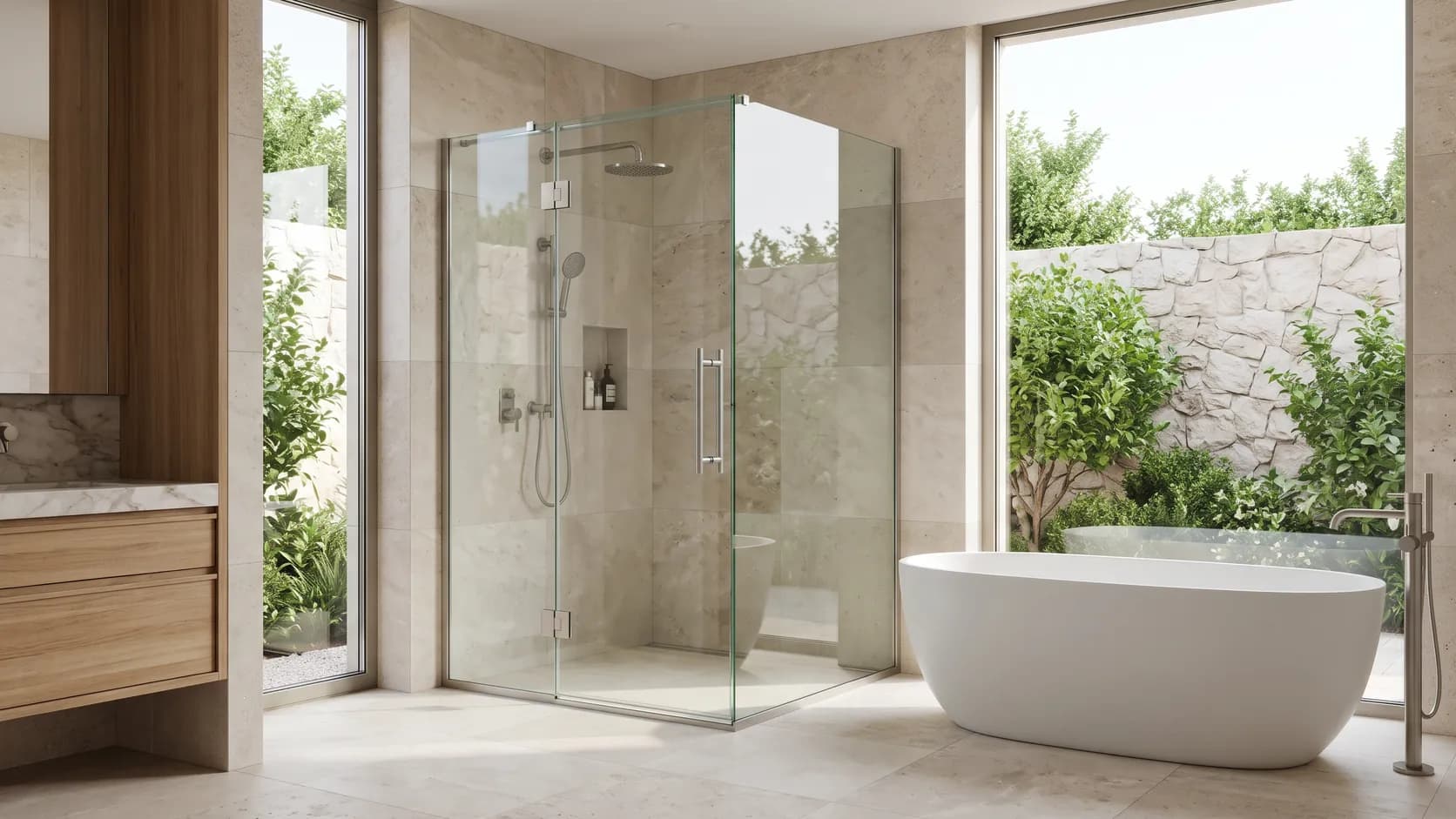
AI-generated illustration, not a photograph of a completed project.
Shower enclosure glass must be tempered, 8 or 10 mm thick: 8 mm for standard doors and panels, 10 mm for wider frameless doors and large fixed panels. Annealed glass is unacceptable: the area is wet and slippery, people stand close, and building codes treat it as a hazardous location needing safety glass. See shower enclosures and tempered glass.
8 mm or 10 mm tempered?
Both 8 mm and 10 mm tempered glass suit shower doors up to 900 mm wide; for wider doors and large fixed panels, 10 mm is more rigid and closes more quietly but is heavier, as glass weighs about 2.5 kg/m² per millimetre.
| Criterion | 8 mm | 10 mm |
|---|---|---|
| Doors up to 900 mm wide | Suitable | Suitable |
| Wider doors | Slight flex | More rigid |
| Large fixed panels | Depends on fixing | Preferred |
| Load on hinges | Lower | Needs stronger hinges |
| Approx. weight per m² | About 20 kg | About 25 kg |
| Example: 900 × 2000 mm door | About 36 kg | About 45 kg |
A 10 mm door 900 mm wide weighs about 45 kg, so its hinges must be rated for at least that weight and width; see the glass thickness guide.
Shower door types: hinged, sliding or a fixed walk-in panel?
The bathroom layout decides the shower door type: a hinged door needs clear swing space, a sliding door suits narrow bathrooms, and a fixed walk-in panel suits large ones.
| Type | Suits | Watch for |
|---|---|---|
| Hinged, 8 or 10 mm | Medium and large bathrooms | Hinge rating, wall strength |
| Sliding, 8 or 10 mm | Narrow bathrooms | Track weight limit, rollers |
| Fixed walk-in, 10 mm preferred | Large bathrooms | Support bar, water spray |
A hinged door hangs on wall-to-glass hinges, fixed solidly into a sound wall clear of pipes, or on glass-to-glass hinges from a fixed side panel. A tall walk-in panel needs a support bar to the wall or ceiling. In master bathrooms of residential villas, fixed glass partitions often replace the curtain.
Hinges, clamps and channels: the hardware sets the thickness
Shower hardware is made for one glass thickness, so choose the model before cutting. Each hinge model's data sheet gives a maximum door weight and width, which may assume two or three hinges; add a third only where the maker allows it. Weak hinges or walls make the door sag. Fixed panels sit in stainless steel clamps or U-channels. Holes and notches follow the model's template and are made before tempering.
Clear, low-iron, frosted or tinted?
In a shower enclosure, glass type decides privacy and how visible limescale spots are: clear and low-iron glass show spots most, frosted glass hides them better and gives privacy, and a grey or bronze tint adds colour but no privacy.
- Clear: most common; its edge looks green from iron oxide, more so when thicker.
- Low-iron: near-colourless edge, preferred where edges show; see low-iron crystal glass.
- Frosted: sandblasted glass shows fingerprints easily; acid-etched glass is smoother, fitted smooth face towards the shower; see decorative glass.
- Grey or bronze tint: a calm colour that does not block the view.
Limescale and Riyadh water: cleaning and coatings
Limescale is a common complaint with Riyadh water, a blend of desalinated seawater and groundwater: evaporating droplets leave minerals as white spots. Squeegee after every shower and use a non-abrasive descaler; abrasive cleaners and metal scrapers scratch the glass. Water-repellent coatings help, but none is permanent: sprayed-on coatings need renewing, and factory-applied ones wear under abrasive cleaning. Ask which kind you are getting and how to maintain it.
Keeping water in: seals, threshold and floor fall
Four things keep water inside a shower enclosure: an even floor fall to the drain, a sweep seal on the door, an inward-sloping threshold and a shower head that does not face the door. Silicone goes on fixed panels only, never on the door.
- Floor fall: international plumbing codes require at least 2%.
- Seal: replace it as it wears.
- Threshold: only a few millimetres of gap under the door.
- Shower head: if it faces the door, set the glass at the threshold's inner edge.
How tempered glass breaks, and why it can break on its own
Tempered glass breaks into small, similar-sized pieces, not long shards: EN 12150-1 requires at least 40 pieces in a 50 × 50 mm square for 4 to 12 mm glass, none longer than 100 mm. The safety glazing section of the Saudi Building Code SBC 201 treats shower doors and enclosures as hazardous locations and requires a permanent manufacturer's mark on each pane; see where safety glass is required.
Sudden breakage usually comes from edge damage, metal contact or a trapped panel, since edges are the weak point; rarely, from a nickel sulphide inclusion. A heat soak test to EN 14179 holds panes at a high temperature for at least two hours, so that panes with a critical inclusion are more likely to break in the oven than after installation; it reduces the risk without removing it and is mostly specified for facades. Ask your supplier whether your project needs it and whether the panels were tested.
Measuring and ordering a shower enclosure, step by step
Measure a shower enclosure only after tiling: a few millimetres of ceramic can make a panel unfittable, and tempered glass cannot be adjusted afterwards. See the processed glass checklist.
- 1. Finish tiles, floor and threshold.
- 2. Choose door type, glass and hardware.
- 3. Measure width at top, middle and bottom, height at both ends, plumb and fall.
- 4. Confirm holes and notches on the hardware template.
- 5. Get sizes confirmed in writing before cutting.
Frequently asked questions
Why can a tempered shower door break on its own?
Usually old edge damage, metal contact or a panel trapped in its frame; rarely a nickel sulphide inclusion. The whole panel is then replaced.
Sliding or hinged shower door: which suits a small bathroom?
Sliding, because it needs no swing space. A hinged door needs clear floor roughly its own width, but opens wider.
How can I tell that shower glass is really tempered?
Look for the manufacturer's permanent mark in a corner of each pane. Glass that someone offers to cut or drill on site is not tempered.
When should a shower enclosure be measured?
After tiles, floor and threshold are finished, because every cut and hole is made before tempering.
At our glass processing factory in Riyadh, backed by our team's 27 years in the industry, we cut, edge and temper 8 and 10 mm shower glass and sandblast it on request; send sizes and a photo through the quote form.
Share this guide
Related Products
Shower Enclosures
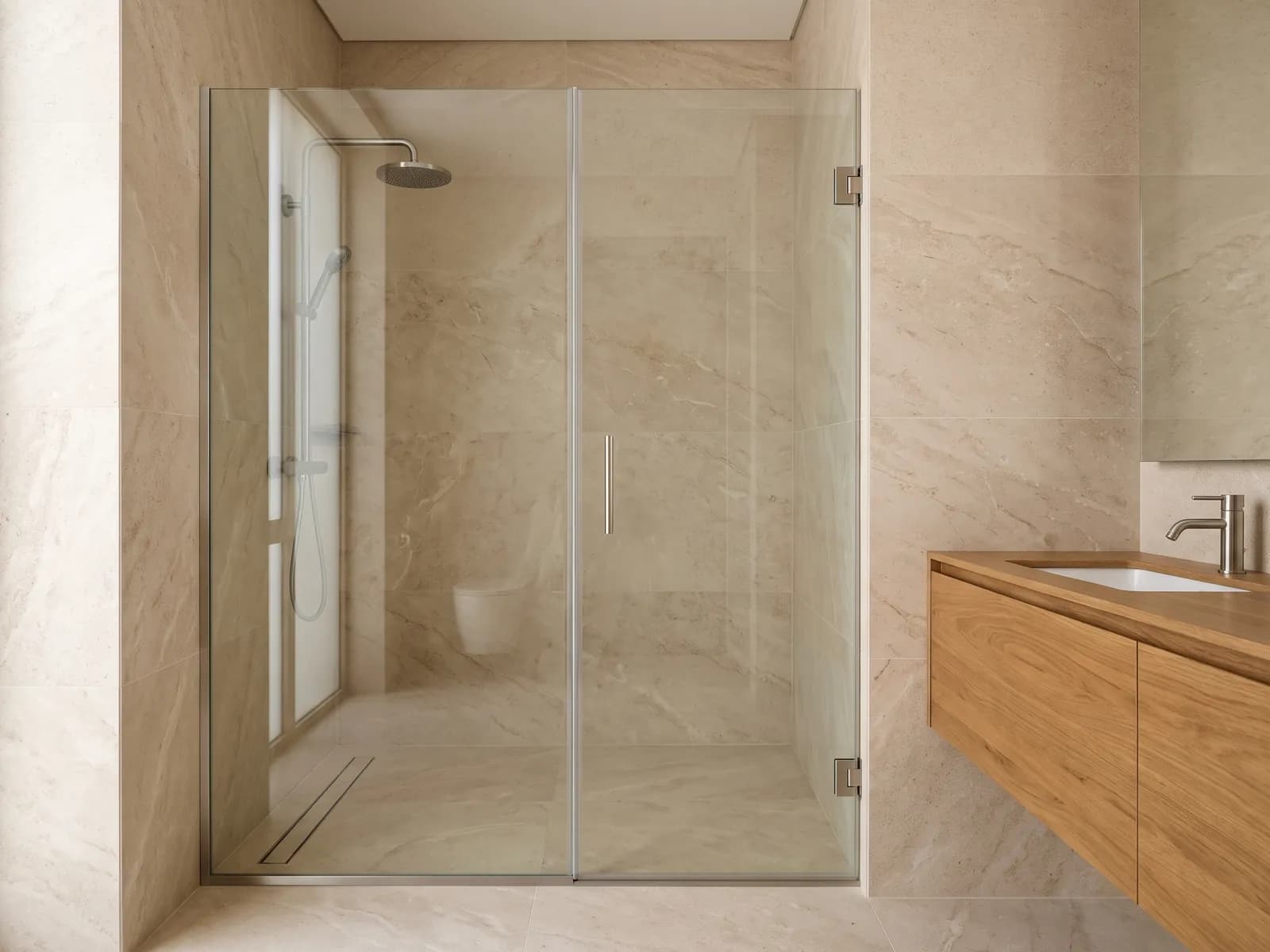
ALFA STAR for Glass makes custom glass shower enclosures to measure in its Riyadh factory, and installation is also available. Tempered glass enclosures in 8 or 10 mm with corrosion-resistant hinges and fittings.
Tempered Glass
Heat treated glass that resists impact and breaks into small blunt granules, making it the standard choice wherever safety matters.