
Tempered Glass in Riyadh: Uses and Selection
Tempered glass is heat-treated glass used where greater resistance and a safety breakage pattern are needed. For a Riyadh villa bathroom, shop door or office partition, the right specification includes the complete panel, its fittings and its supports—not thickness alone.
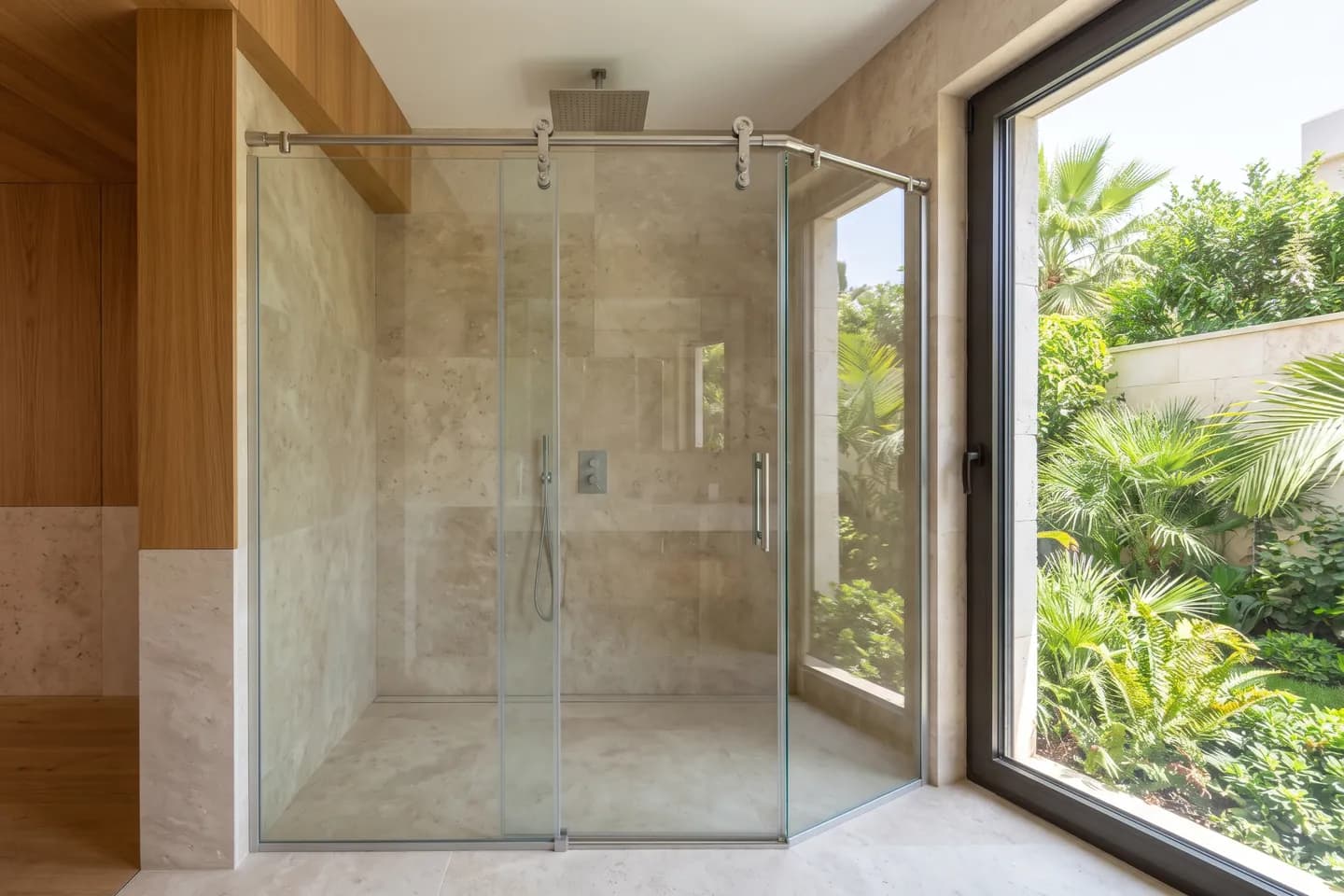
AI-generated product application illustration; not a photograph of a completed project.
Tempering is a heat treatment that changes the structure of glass from the inside. The sheet is heated to around 620 °C - close to its softening point - then its surfaces are cooled by jets of compressed air within seconds.
The surfaces cool and set first, the core after. That difference leaves the surfaces under compressive stress and the core under tension, and glass under compression is far stronger.
What actually changes
| Property | Before tempering | After |
|---|---|---|
| Impact resistance | Baseline | Several times higher |
| Breakage behaviour | Sharp shards | Small, blunt granules |
| Thermal shock resistance | Limited | High |
| Cutting and drilling | Possible | Not possible |
The rule with no exceptions
Every cut, hole, notch and edge treatment must happen before the furnace. After tempering the sheet cannot be touched: any attempt to cut or drill destroys it completely, because breaking the compressed surface releases the stored stress across the whole pane at once.
This is why final sizes are confirmed before production starts. Changing a dimension after the furnace means a new sheet, not an adjustment.
Roller wave
The sheet travels over rollers while hot, leaving a fine optical waviness visible in reflection at certain angles. This is not a manufacturing defect but a property inherent to horizontal tempering. It is taken into account when choosing sheet orientation on large facades.
A rare case worth stating
Tempered glass can break spontaneously months later because of microscopic nickel sulphide inclusions present in the original glass. The probability is low but not zero, which is why sensitive facades call for heat soak treatment, forcing such cases to appear in the factory rather than in the building.
For the product itself see tempered glass.
Where does tempered glass work well?
Transparent shower screens keep a bathroom visually open while separating wet and dry areas. Glass doors and internal partitions admit daylight and preserve sightlines between rooms. The frame, hinges, handles and clearances must be coordinated with the glass before manufacture. The illustration shows a shower application; it does not establish a glass specification from appearance.
Tempered or laminated: which should you choose?
Tempering and lamination perform different jobs. Tempering changes the strength and breakage behaviour of a pane; lamination bonds panes with an interlayer that helps retain fragments. A laminated assembly can also use heat-treated panes. Balconies, overhead glazing and other locations needing retention after breakage require a project-specific assembly and support design. Do not substitute a single tempered pane merely because it looks similar.
Planning a glass order in Riyadh
For a villa renovation, confirm finished wall and floor levels before final measurement. For an office fit-out, coordinate door swings, access and the chosen hardware. State whether edges remain exposed or sit in a frame. Holes, notches and edge work must be specified before tempering; a finished tempered pane cannot be resized like ordinary annealed glass.
What affects the quotation?
Panel dimensions, glass composition, edge finish, hole layout, quantities and hardware interfaces all affect processing. Send dimensioned drawings, the application, the delivery location in Saudi Arabia and photographs of the opening if available. ALFA STAR for Glass in Riyadh can review the processing requirements against that information; installation scope and project-specific compliance should be confirmed in the quotation.
Frequently asked questions
Does tempered glass also insulate against heat?
Tempering is a heat treatment, not an insulating cavity or solar-control coating. Exterior thermal performance depends on the complete glazing specification.
Can a hinge hole be added after tempering?
No. Finalise the hinge model, hole positions and cut-outs before heat treatment. A changed layout normally requires a new pane.