
Custom Glass Cutting & Polished Edges in Riyadh
Custom cutting sets the shape of the glass; edging refines its perimeter; beveling creates an angled decorative edge. Together they turn a glass sheet into a panel suited to a specific mirror, furniture piece, partition or door. Accurate drawings make the finish usable as well as attractive.
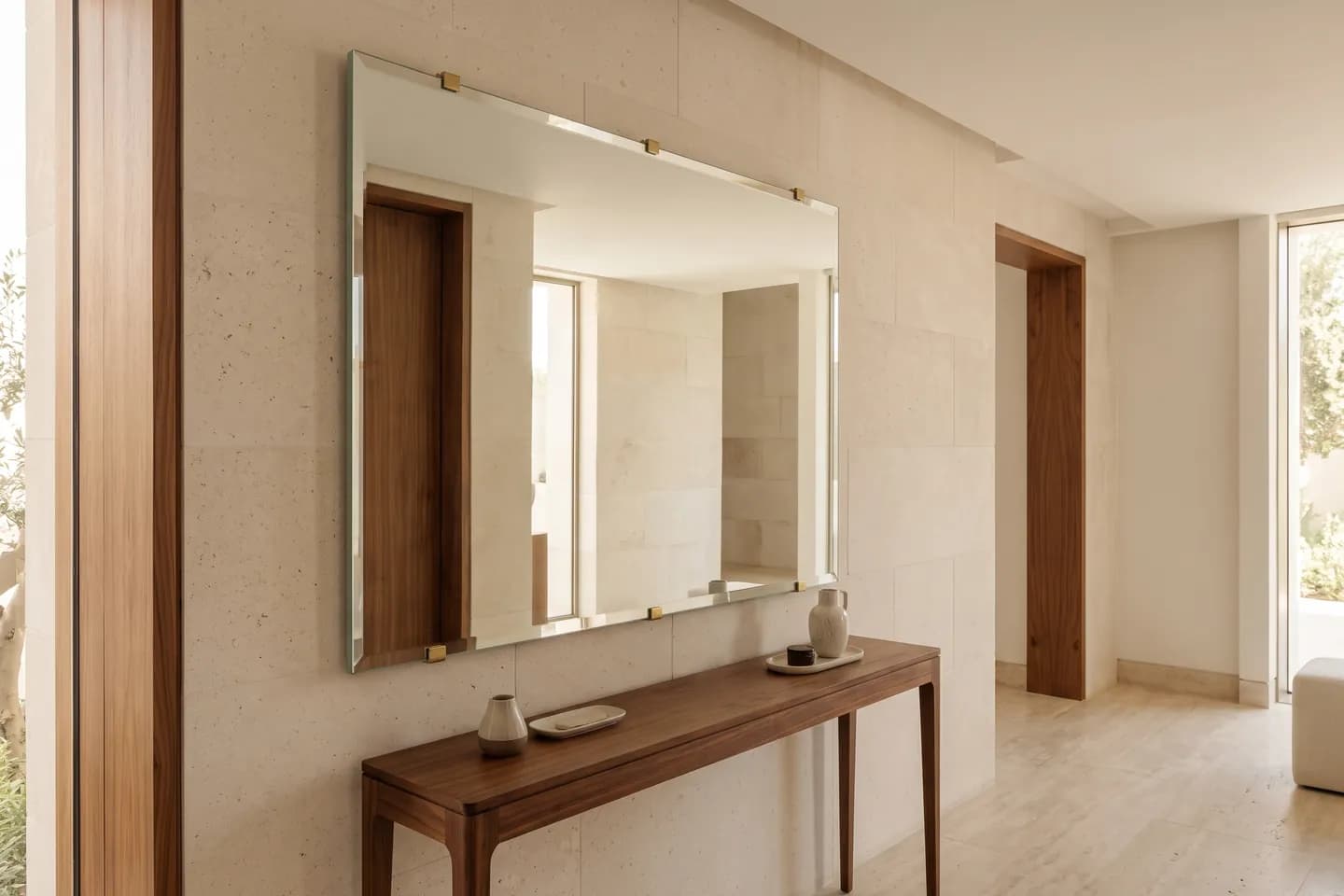
AI-generated product application illustration; not a photograph of a completed project.
Cutting, edging and beveling are three sequential operations that set the final shape of a sheet and its integrity. All of them come before any heat treatment.
Cutting
Glass is not cut but scored and broken: a hard wheel makes a fine line on the surface, a microscopic crack forms beneath it, and pressure then separates the sheet along that line.
Accuracy here carries into everything after it: a sheet cut out of square cannot be corrected by edging.
Edging, and why it is a safety matter rather than a cosmetic one
A cut edge is sharp and carries microscopic cracks. Those cracks are the origin of breakage: under load or heat, a fracture starts at the edge, not in the middle of the pane.
The edge is therefore always worked, even where it will be hidden inside a frame. On a sheet destined for tempering the point is sharper still: a damaged edge leaves the furnace with uneven stress.
| Finish | Description | Where it is used |
|---|---|---|
| Arrised | Sharpness removed only | Inside frames |
| Ground | Uniform matt edge | Exposed edges |
| Polished | Clear, glossy edge | Tables and shelves |
| Bullnose | Soft curved edge | Surfaces that are touched |
Beveling
Removing an angled band around the face, 10 to 25 mm wide. The bevel refracts light at the border, producing a bright line around the panel.
It is frequently requested on mirrors, table tops and cabinet fronts.
Holes and notches
Every hole and notch is executed at this stage, and each has a minimum distance from the edge and from other holes. A hole placed near the edge weakens the sheet exactly where it is already most sensitive.
What is the difference between edge finishes?
An arrised edge has its sharp corners eased and is often specified where the edge will be concealed. A ground edge has a matte finish; a polished edge gives exposed glass a clearer, smoother visual line. A bevel is an angled face near the perimeter, commonly selected as a decorative detail for mirrors and furniture. These finishes are not interchangeable: choose them according to visibility, handling and the intended assembly.
Applications in Riyadh interiors
For a villa console or tabletop, the glass shape, corners and visible edge are part of the design. In fitted mirrors, the bevel needs to work with sockets, wall joints and adjacent finishes. In office partitions and doors, the processing must also accommodate clamps, hinges and handles. The illustration shows a polished tabletop and a bevelled mirror; it is an example of finish and appearance, not a load-bearing design.
What should be on the drawing?
Record finished dimensions, glass type, thickness, quantities and the finish required on each edge. Locate holes and cut-outs from a consistent reference edge and attach the hardware manufacturer’s template where available. Identify corners, curves, handed parts and the visible face. Check that measurements reflect finished surfaces; nominal room dimensions may differ from the actual opening.
Coordinate cutting before heat treatment
Where tempering is required, cutting, drilling and edge work must be resolved before heat treatment. Do not plan to trim a finished tempered panel on site. For a quotation from ALFA STAR for Glass in Riyadh, provide the drawing and application together, plus the project location in Saudi Arabia. Confirm measurement, installation and delivery responsibilities so the approved drawing matches the intended scope.
Frequently asked questions
Does polishing make a pane tempered?
No. Polishing is edge finishing. Tempering is a separate heat treatment selected for the application.
Can a bevel be specified by a reference photograph alone?
A photograph helps communicate appearance, but the drawing should also state the required bevel and finished dimensions. Confirm a sample when visual matching matters.