
Glass Tables
Glass table tops cut to size: dining, meeting and side tables, and protective tops over timber furniture. Always tempered, with edges finished before use.
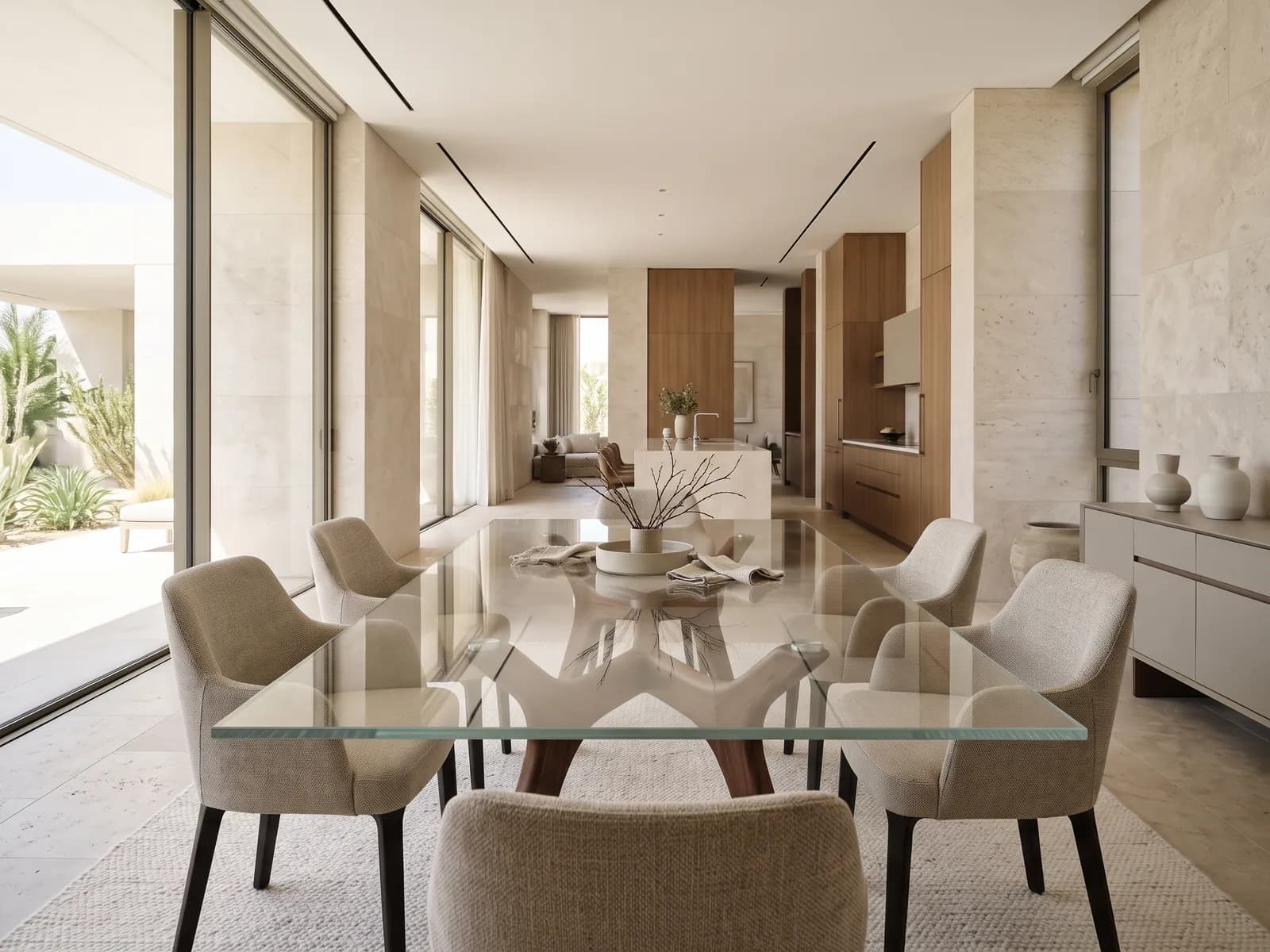
Short answer: ALFA STAR for Glass makes tempered glass table tops and protective tops to size at our Riyadh factory: round, rectangular or shaped, with polished, bevelled or bullnose edges, in clear or low-iron glass. The thickness follows the span between supports, as the table below shows.
A glass table top takes direct load, point impacts and daily abrasion. It is therefore never made in annealed glass: tempering is a requirement, because an annealed sheet breaks into sharp shards at exactly seating height.
Thickness by span
| Span between supports | Usual thickness |
|---|---|
| Up to 60 cm | 8 mm |
| 60 - 100 cm | 10 mm |
| 100 - 140 cm | 12 mm |
| Over 140 cm | 15 - 19 mm, or an added support |
The table is indicative: the final figure depends on base shape, number of support points and how the table is used.
The edge
The edge is the most important detail on a table, because it is the part people touch:
- Polished edge: the most requested on dining tables.
- Bevelled edge: an angled bevel giving a line of light around the top.
- Bullnose edge: softer to the touch, suited to homes with children.
Colour on a large surface
Across a large table the natural green cast in ordinary glass edges becomes visible, particularly over pale surfaces. The answer is low-iron glass: an almost colourless edge and faithful rendering of whatever sits beneath.
Protective tops
A thin sheet - 5 to 8 mm - laid over a timber table to protect it. This is tempered too, with clear pads that prevent direct contact and let air move underneath.
What to send for a quotation
- The shape and size of the top, or a template for an irregular shape.
- The base or table it sits on and the span between its supports.
- The edge finish you want and whether you prefer clear or low-iron glass.
- The quantity and the location in Riyadh or elsewhere in Saudi Arabia.
Send them through the quotation form.
Key Advantages
- Always tempered
- Polished or bevelled edges
- Thickness calculated from span
Applications
- Dining and meeting tables
- Side tables
- Protective tops over timber
Frequently Asked Questions
What thickness should a glass table top be?
It is calculated from the span between supports. As a guide: up to 60 cm 8 mm is enough, 60 to 100 cm takes 10 mm, 100 to 140 cm 12 mm, and above that 15 - 19 mm or an added support. Base shape and the number of support points change the calculation.
Must a glass table top be tempered?
Yes. The surface takes direct load, point impacts and daily abrasion, and an annealed pane breaks into sharp shards at exactly seating height. Tempering is a requirement rather than an option in this use.
When is low-iron glass preferred for tables?
When the colour beneath the surface matters. Across a large table the natural green cast in ordinary glass edges becomes visible, especially over pale surfaces. Low-iron glass gives an almost colourless edge and renders what sits beneath it faithfully.
Do you make glass table tops in irregular shapes?
Yes. Send a full-size template in card or wood, or an accurate drawing; the glass is cut to it, the edges are finished and then it is tempered. Cutting is done before tempering, because tempered glass cannot be cut afterwards.
Request a Quote
Request a Quote