
LED Mirror or Standard Mirror? A Selection Guide for Bathrooms and Dressing Rooms
September 25, 2026 · 6 min read
An LED mirror adds frontal light and a demister; a standard mirror costs less and suits large walls. This guide explains when to choose each in Riyadh.
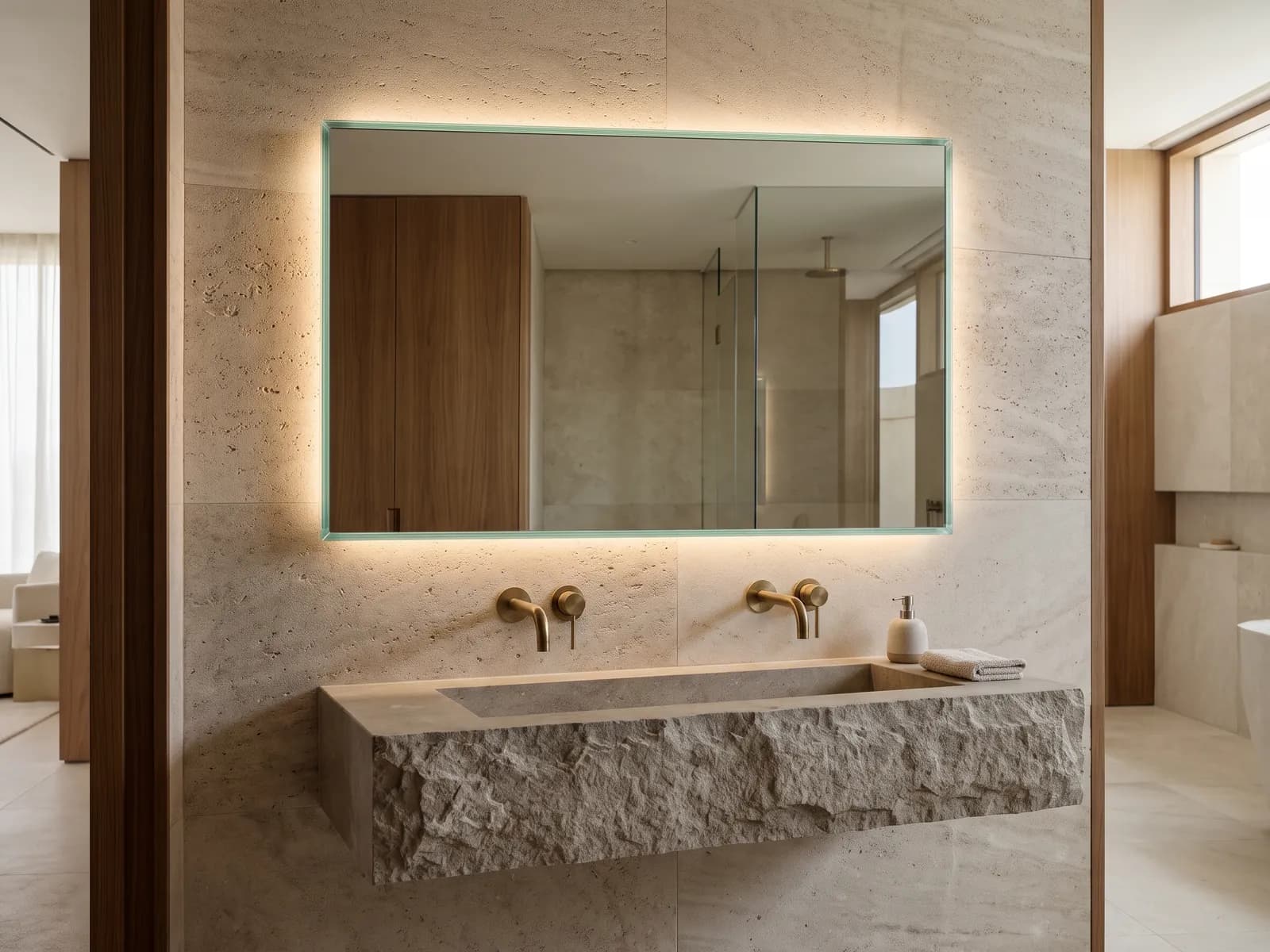
An LED mirror is a standard silvered mirror with a light source built into or behind the glass, while a standard mirror relies on the room's lighting. In a Riyadh bathroom or dressing room the choice comes down to four things: how the space is lit, how humid it gets, how much wall you have, and whether you want the mirror to double as a light fixture.
What the two types actually are
A standard mirror is float glass, usually 4 to 6 mm thick, with a silver coating and protective paint on the back. It is cut to size, its edges are polished or beveled, and it is fixed to the wall with adhesive or clips. It has no electrical part and no maintenance beyond cleaning. Our mirrors and LED mirrors page shows the finishes and edge options we produce.
An LED mirror uses the same mirror glass, but part of the silver layer is removed in a pattern and a strip of LEDs sits behind it, or the LEDs run around the edge and light the wall. It needs a power connection, a driver, and often a touch switch, a demister pad and a colour-temperature control. The glass itself is still cut, edged and drilled in the same factory process as a plain mirror.
LED mirror vs standard mirror: comparison
| Criterion | Standard mirror | LED mirror |
|---|---|---|
| Light quality | Depends on ceiling or wall lights, often shadows on the face | Even frontal light, usually 3000 to 6000 K adjustable |
| Electrical work | None | Needs a supply point behind the mirror |
| Humidity | Silver backing only; copper-free backing recommended | Sealed LED strip, IP44 rated driver expected |
| Anti-fog | Not available | Demister pad, common in Riyadh bathrooms |
| Typical thickness | 4 to 6 mm | 5 mm (drilled or frosted areas need the extra strength) |
| Sizes | Any cut size, large panels possible | Limited by the LED module and driver layout |
| Cost | Lowest | Higher, but replaces a separate vanity light |
| Best for | Dressing rooms, hallways, large feature walls | Bathrooms, hotel rooms, makeup areas |
When a standard mirror is the better choice
Choose a standard mirror when the room already has good frontal lighting, when you need a very large or unusually shaped panel, or when the mirror is decorative rather than functional. Wall-to-wall mirrors in a gym, a corridor or a dining room fall in this group. Here the money is better spent on low-iron crystal glass, which removes the green tint, or on a bevel that catches the light.
In a humid bathroom a standard mirror still works, but ask for a copper-free silver backing. Ordinary silvering can develop dark edges after a few years of steam and cleaning chemicals; copper-free backing resists that corrosion. For a mirror fitted inside a shower enclosure area, the glass should also be tempered, because it is a wet zone.
When an LED mirror is worth it
Choose an LED mirror when the mirror is used for shaving or makeup, when the bathroom has a single ceiling light, or when you want fewer fixtures on the wall. The frontal light removes shadows under the eyes and chin, which a downlight above the basin cannot do. A demister pad keeps the centre of the glass clear after a hot shower, which matters most in summer when the air conditioning cools the glass.
For hotels and serviced apartments, the LED mirror also simplifies the wall: one supply point, one fixture, one cleaning surface. Our hospitality projects usually specify a touch switch with a colour-temperature change, because guests expect both warm and cool light.
Practical checks before you order
- Measure the wall, not the old mirror: tiles and vanity edges are rarely square.
- Decide the mounting: adhesive on a smooth wall, or clips and a frame on tiles.
- For LED, confirm the electrical point is behind the mirror area before the tiling is finished.
- Ask for polished or beveled edges on any exposed side; a cut edge is sharp and chips.
- Check the room for direct sunlight: strong afternoon sun through a window reflects off a large mirror and heats the wall behind it.
Frequently asked questions
Does an LED mirror need a special electrician?
No. It needs a standard supply point behind the mirror, usually 220 V, connected to the driver supplied with the mirror. Any licensed electrician can do it, but the point must exist before the mirror is fixed.
How thick should a bathroom mirror be?
4 mm is enough for panels under about one square metre. Use 5 or 6 mm for larger panels or where the mirror is drilled or has a frosted lighting pattern.
Can an LED mirror be made to a custom size?
Yes, within the limits of the LED layout. Custom widths are simple; custom shapes such as arches or circles are possible but the lighting pattern must be designed for them.
Will the mirror fog in a Riyadh bathroom?
Any mirror fogs when hot steam meets a glass surface cooled by air conditioning. A demister pad behind the glass keeps a defined area clear; it is a small heating film and is switched with the light.
If you are choosing between the two for a specific room, send us the wall size and a photo through the quote form and we will suggest the right type, thickness and edge finish.