
Clear Float Glass
The flat sheet every later process starts from: cutting, tempering, lamination, insulation. Made by the float process, so both surfaces are parallel and free of optical distortion. Available from 4 mm to 19 mm.
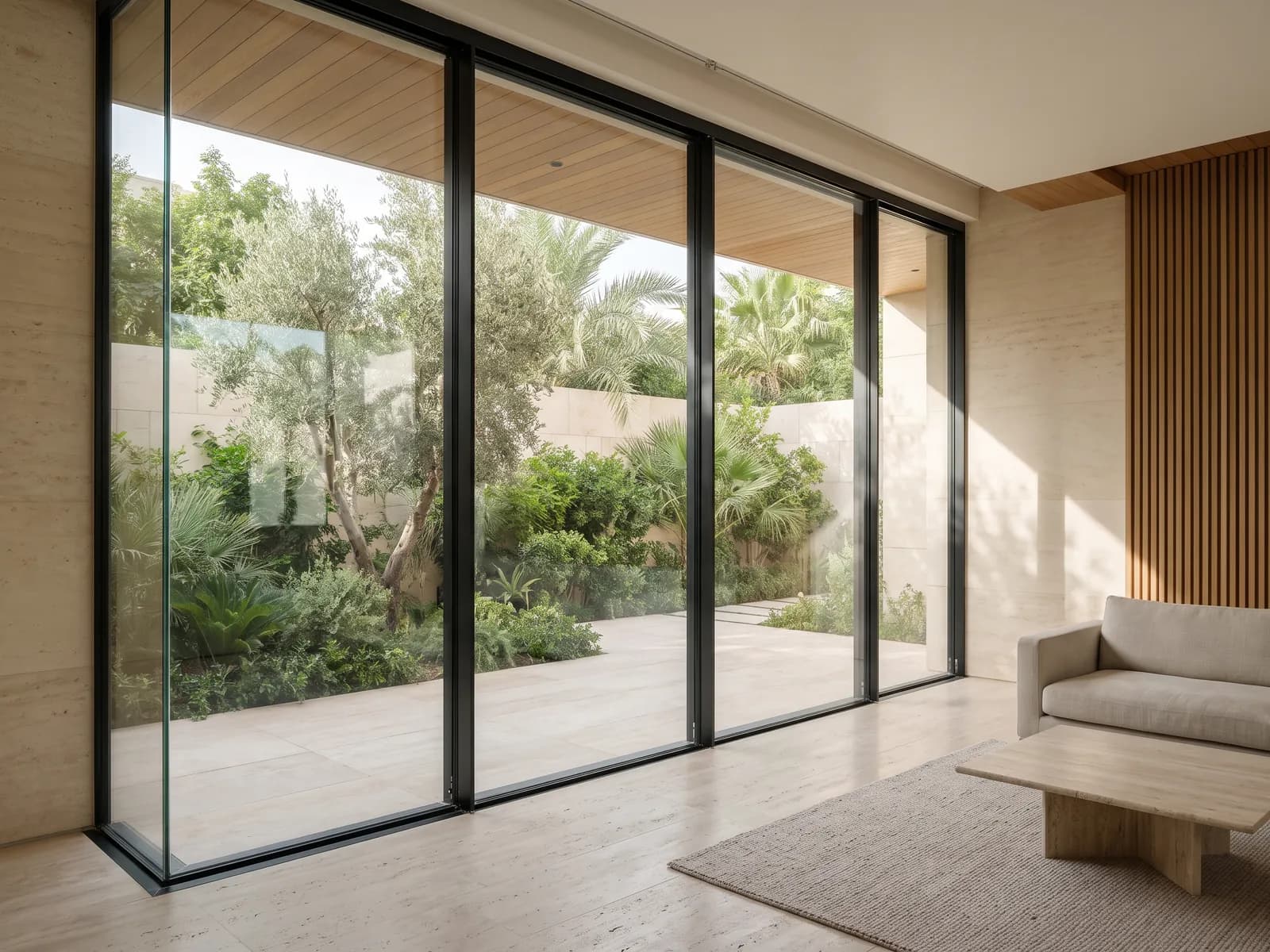
Short answer: clear float glass is ordinary flat glass and the starting sheet for tempered, laminated and insulated glass. ALFA STAR for Glass cuts it to size in Riyadh in thicknesses from 4 to 19 mm, with ground or polished edges and holes, for windows, frames, shelves and table tops. Where people can touch or fall against it, it is tempered or laminated first.
Clear float glass is ordinary flat glass made by the float process: raw materials are melted and poured onto a bath of molten tin, where gravity levels the sheet and both surfaces come out parallel. That is what makes it free of the optical waviness of older production methods.
In most uses it is not a finished product but the raw material: tempering, lamination and insulation all start from a clear sheet.
Choosing a thickness
| Thickness | Typical use |
|---|---|
| 4 - 5 mm | Picture framing, light interior doors, small panels |
| 6 mm | Interior partitions, insulating units, medium windows |
| 8 - 10 mm | Glass doors, interior facades, load-bearing shelves |
| 12 mm | Frameless doors, balustrades, large partitions |
| 15 - 19 mm | Large glazed facades, floors, long-span surfaces |
Thickness is not chosen by taste: it follows from panel area, wind load and fixing method.
The green edge
All ordinary clear glass contains iron oxide, which gives the edge a green cast that becomes more visible as thickness increases. Where the surface is large or true colour matters - a display facade, a lit shelf, a table top - low-iron glass is used instead.
What it does not do on its own
- It is not safety glass. Unless tempered or laminated it breaks into sharp shards.
- It does not insulate by itself. Insulation comes from a sealed unit or a coating.
- It does not provide privacy. That needs frosting, a film, or smart glass.
What to send for a quotation
- The size and quantity of each piece, or a drawing.
- The thickness if it is specified, or what the glass is for so we can recommend one.
- The edge finish and any holes or cut-outs.
- Whether it needs to be tempered or laminated, and the location in Riyadh or elsewhere in Saudi Arabia.
Send them through the quotation form.
Key Advantages
- Free of optical distortion
- Available 4 mm to 19 mm
- Base for every downstream process
Technical Specifications
| Thickness | 4 - 19 mm |
|---|
Applications
- Windows and interior partitions
- Insulating glass units
- Shelves and surfaces
Frequently Asked Questions
What thickness of clear glass do I need?
It follows from the span between supports, the fixing method and the load - not from taste. As a guide: up to 1 m² 6 mm is enough, 1 to 2.5 m² takes 8 mm, above that 10 - 12 mm. Point fixing raises the thickness because load concentrates around the holes.
Why does the edge of clear glass look green?
Because ordinary glass contains iron oxide in its composition, which gives the edge a green cast that becomes stronger with thickness. Where true colour matters - a display front, a lit shelf, a table top - low-iron glass is used instead.
Is clear glass safety glass?
No. An ordinary clear pane breaks into sharp shards however thick it is. Safety comes from tempering or lamination, and both are treatments entirely independent of thickness.
Do you cut clear glass to size for individual customers?
Yes, we cut glass to size for projects and for individual customers, with edge finishing and holes. Send the sizes, quantity and use so we can confirm the thickness and send a quotation.
Request a Quote
Request a Quote